

Roth, 401(k), 403(b), IRA, HSA, 457(b), 529, SEP, UTMA, UGMA … do you ever feel like you’re lost in an alphabet soup or a nightmare from a toddler cartoon when someone tries to talk to you about retirement planning? The thought of trying to keep track of all those account types will make anyone go “UGMA.”
So let’s cut down the jargon and explain in plain English: The Three Main Types of Investment Accounts
You do not need to memorize every acronym before you can understand how your money is being taxed. For retirement planning, most investment accounts can be understood by starting with three basic tax buckets:
Traditional. Roth. Taxable.
There are accounts with their own special rules—HSAs and 529 plans are good examples—but understanding these three tax treatments gives you a framework for making sense of most retirement savings.
And the biggest difference between them is not necessarily what you invest in.
It is when you pay taxes.
One Picture Explains Most of It
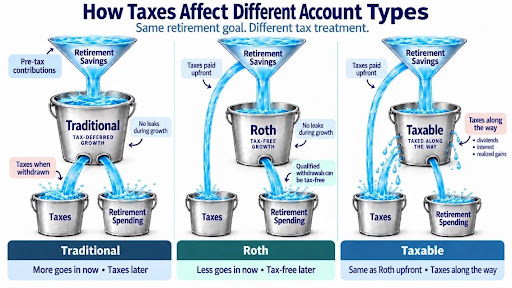
The graphic above gives us a simple way to visualize the difference.
With a Traditional account, more of your savings can get into the account because the tax can be deferred until later.
With a Roth account, taxes are paid before the money gets into the account, but qualified withdrawals can ultimately come out tax-free.
With a taxable account, taxes have already been paid on the money you invest, but additional taxes can leak out while the account is growing.
That is the basic framework.
And once you understand it, a lot of the alphabet soup starts to become much easier to organize.
Bucket #1: Traditional — Pre-Tax Now, Pay Tax Later
Let’s start with Traditional retirement accounts.
Generally, Traditional = Pre-Tax. And if you don’t see “Roth” before the name, it’s most likely Traditional.
You might see names like:
- Traditional 401(k)
- Traditional IRA
- 403(b)
- 457(b)
- SEP IRA
Those names describe different types of plans, but from a tax perspective, the basic idea is similar.
They are all pre-tax accounts. You receive a tax benefit when the money goes into the account.
For example, if you earn $10,000 and contribute that money pre-tax to a Traditional retirement account, the full $10,000 is deducted from your taxable income that year.
Once the money is inside, it generally grows tax-deferred.
That means you are not receiving an annual tax bill just because investments inside the account paid dividends, earned interest, or were sold at a gain.
The tradeoff comes later.
When previously untaxed money is withdrawn in retirement, those withdrawals are generally taxable as ordinary income.
So in plain English:
Traditional = tax break now, pay taxes later.
Or using the bucket analogy:
More goes into the bucket today, but some of the water goes to taxes when you eventually pour it back out.
Bucket #2: Roth — Pay the Tax Now, Avoid Taxes Later
You might see names like:
- Roth 401(k)
- Roth IRA
- Roth 403(b)
- Roth 457(b)
We call these accounts after-tax because they flip the process around.
Instead of receiving the tax benefit when the money goes in, you pay the tax first.
Suppose again that you earned $10,000.
If your tax rate were 25%, you would pay $2,500 in tax first, leaving $7,500 to put into the Roth.
So compared with the Traditional account, less money initially reaches the investment account.
But that is where the Roth benefit begins.
The money can grow without annual tax drag, and qualified withdrawals come out tax-free.
So:
Roth = taxes now, tax break later.
Using the bucket analogy:
Less water gets into the bucket at the beginning because taxes have already taken their share. But when you eventually use the money, qualified withdrawals all go towards retirement spending without another tax bill.
Bucket #3: Taxable — More Taxes but More Flexibility
Then we have a regular taxable investment account.
This might simply be called a:
- Brokerage account
- Individual account
- Joint account
- Trust account
- TOD account
- Savings account
Like Roth savings, the money going into a taxable account has generally already been taxed.
But unlike a Roth, the account does not receive the same protection from taxes while the investments are growing.
Depending on what you own, you may owe taxes on things such as:
- Dividends
- Interest
- Capital-gain distributions
- Realized gains when you sell investments.
Those taxes can create what is called tax drag.
Every dollar that leaves the account to pay taxes is a dollar that is no longer invested and compounding.
But the benefit is flexibility.
Retirement accounts (Traditional & Roth) have withdrawal age restrictions and contribution limits that taxable accounts don’t have.
So:
Taxable = after-tax money goes in, taxes may occur along the way, but the money is highly accessible.
Why Having All Three Can Be Powerful
One of the most useful positions a retiree can be in is having money available in all three buckets.
Why?
Because retirement does not look the same every year.
You may have a pre-retirement emergency that makes the accessibility of the Taxable account worth the tax drag.
And retirement does not look the same every year. If all your retirement savings are in one type of account, you’ll have fewer choices.
Entering retirement with Taxable, Traditional, and Roth assets, gives you extremely valuable flexibility.
You Do Not Need to Memorize the Alphabet Soup
A 401(k) and an IRA are not the same account.
Neither are a 403(b), SEP IRA, HSA, or 529.
They each have their own contribution limits, eligibility rules, withdrawal rules, and planning uses.
But you do not need to memorize every acronym before you can understand the bigger picture.
Start with one question:
How is this money taxed?
Is the tax benefit happening now?
Is it happening later?
Or is the account being taxed along the way?
Once you understand that, the acronyms start becoming much easier to sort out.
And hopefully the next time someone starts throwing around phrases like 401(k), IRA, Roth, SEP, 457(b), UTMA, and UGMA…
you will feel a little less “UGMA.”
This article is for educational purposes only and is not intended as individualized investment, tax, or legal advice. Tax laws, retirement-account rules, and individual circumstances can change. Consult the appropriate professionals regarding your specific situation.