

When people think about saving for retirement, they usually focus on two questions: How much am I saving, and what return am I earning?
Taxes are an important third variable that often gets overlooked.
The cost of taxes is not limited to the amount that leaves your account today. When money is paid in taxes, that money also loses the opportunity to remain invested and compound in the future. Over a long retirement, that lost growth can become meaningful.
That is one reason the type of account you save in can matter almost as much as the investments you own.
The Hidden Cost of Tax Drag
Consider a simplified example:
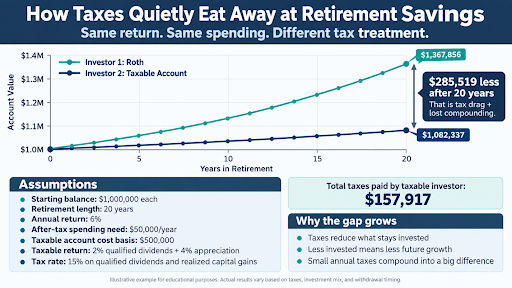
Two retirees each begin retirement with $1 million. Both portfolios earn a 6% annual return, and both retirees need $50,000 of after-tax spending each year.
Investor 1 holds the money in a Roth account and makes qualified tax-free withdrawals.
Investor 2 holds the money in a taxable investment account with an initial cost basis of $500,000. We assume the portfolio’s 6% return consists of 2% qualified dividends and 4% appreciation, with qualified dividends and realized capital gains taxed at 15%.
After 20 years:
Roth account: approximately $1,367,856 million
Taxable account: approximately $1,082,337 million
That is a difference of approximately $286,000.
Interestingly, the taxable investor paid about $158,000 in taxes during the 20-year period. The difference between the two ending balances is considerably larger than the tax bill itself.
Why?
Because every dollar used to pay taxes was also a dollar that could no longer earn investment returns.
Taxes reduced the amount that stayed invested. That reduced future growth. Then the lower balance generated less growth again the following year.
That is tax drag.
Taxes Can Affect More Than This Year's Return
Taxes you pay now could have remained invested for many years, causing the total economic costs to be higher.
That distinction becomes increasingly important as the time horizon gets longer.
Small recurring taxes on dividends, interest and realized gains may not look particularly significant in any individual year.
Over decades, however, repeatedly removing money from an investment portfolio can meaningfully reduce the amount that ultimately compounds.
Why Retirement Accounts Can Be So Powerful
This is why retirement accounts can be so valuable.
Generally speaking, retirement accounts are not being taxed as dividends, interests, and capital gains are being realized in the account.
That gives more of the portfolio the opportunity to stay invested.
Over a long period of time, that can be powerful.
The goal is not simply to avoid paying taxes.
Either way, the tax treatment allows the underlying investments to compound without intermittent taxes being paid along the way.
Why Taxable Accounts Still Matter
Tax efficiency is valuable, but so is flexibility.
Retirement accounts generally come with rules around contributions and access. Money placed into a retirement account is intended primarily for retirement, and accessing it early can create taxes, penalties or other limitations depending on the account and circumstances.
A taxable investment account does not have those same retirement-specific restrictions.
That can make taxable savings especially useful for goals or emergencies that may occur before traditional retirement age.
Taxable accounts can also provide additional flexibility during the transition into retirement.
Someone who retires before drawing Social Security or before beginning distributions from retirement accounts, may use taxable assets to help fund those early retirement years.
That flexibility can create planning opportunities elsewhere.
So the takeaway is not that retirement accounts are always better and taxable accounts are something to avoid.
A better way to think about it is:
Use retirement accounts intentionally for retirement savings, while using taxable accounts to preserve flexibility for goals and spending that may happen before or around retirement.
For many people, the strongest plan includes both.
The Bigger Lesson
The example above is intentionally simplified.
Real portfolios may generate different combinations of dividends, interest, capital gains and losses. Tax rates vary. Investment returns vary. Spending changes. And retirement accounts have rules and restrictions that need to be considered.
But the broader lesson remains important:
Taxes affect compounding.
And one of the most powerful tools investors have for managing that effect is the retirement account itself.
The goal is not to place every dollar into one particular type of account.
It is to understand the tax advantages available to you and use the appropriate accounts intentionally while you are saving for retirement.
Because over decades, it’s not just the investments you make that impact your return, but the accounts that you hold those investments in as well.
This article is for educational purposes only and is not intended as individualized investment, tax or legal advice. Tax laws and individual circumstances vary. Consult the appropriate professionals regarding your specific situation.